Why Gas Station Marketing Looks Different in 2026
If you own one store — or a handful — you are the typical American fuel retailer. Of the roughly 152,000 convenience stores in the United States, about 63% belong to companies running ten locations or fewer. Texas alone has more than 16,500 stores, more than any other state, and it added more stores last year than anywhere else in the country.
That matters because most gas station marketing advice is written for chains with a marketing department. This guide is written for the operator who is also the buyer, the scheduler, and the person who unlocks the door.
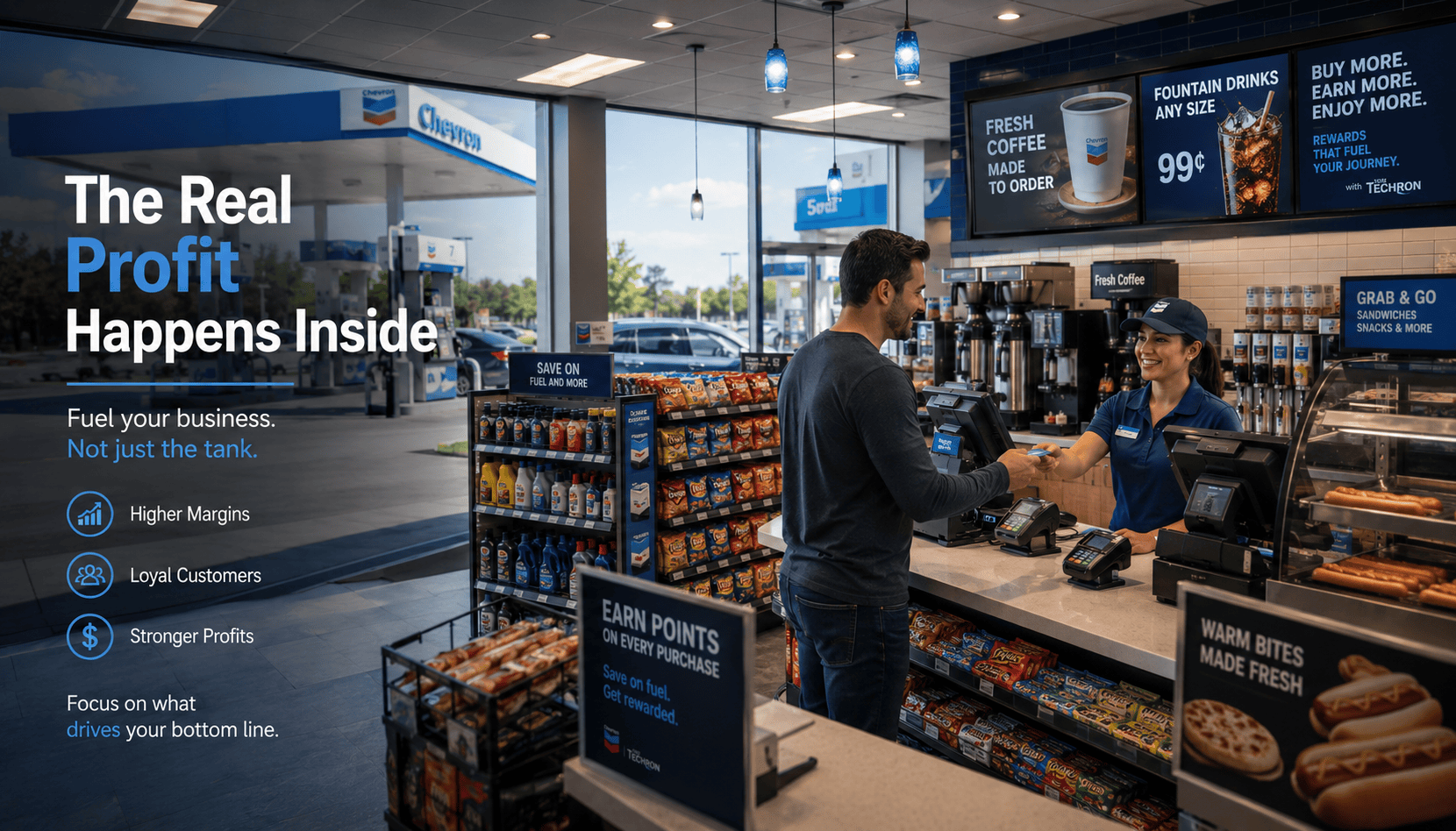
The single most important shift to understand is this: fuel brings people to your lot, but the store is where you actually make money. Industry-wide, fuel accounts for roughly 65% of sales dollars but under 40% of gross profit. Foodservice alone now delivers close to 39% of in-store gross profit — a category that was barely a tenth of in-store sales two decades ago.
Marketing that only pushes street price is competing in the low-margin half of your business. The strategy below works the other way around.
Start With the Number That Actually Matters
The average convenience store handled about 45,160 transactions per month in 2025 — roughly 1,484 a day, and down 2.7% year over year. Customer counts are shrinking across the industry.
Before spending a dollar on marketing, know three numbers for your own site:
- Daily transaction count — pull it from your POS, not from memory.
- Inside conversion rate — of the drivers who buy fuel, what share comes in? Many independents sit between 20% and 40%. Every point you add is pure margin.
- Average basket — what a customer spends inside, per visit.
Those three numbers tell you which problem you have. Falling transactions is a traffic problem. Low conversion is a layout, signage and offer problem. A small basket is a merchandising problem. They need completely different fixes, and most owners guess wrong about which one they’ve got.
The Four Levers You Actually Control
1. Get more cars onto the lot
Local search is where this is won now. A complete Google Business Profile with current hours, accurate fuel brands, photos of the forecourt and the store interior, and steady review activity does more for a single-site operator than almost any paid channel. Most independent stations have a thin or unclaimed profile — which is exactly why claiming and building one is such cheap ground to take.
Beyond that: clear, readable price signage from the road, well-lit approaches at night, and easy in-and-out access. A confusing entrance costs you customers who never appear in any report.
2. Convert fuel customers into store customers
This is the highest-return lever most independents ignore. A driver at your pump has already chosen you. Getting them through the door costs nothing extra in acquisition.
What works: pump-topper offers tied to something they actually want, a visible restroom sign (a surprising share of stops start there), coffee and fountain visible from outside, and staff who acknowledge people. Pump-to-store offers work best when the redemption is immediate and the offer is specific — a named item at a named price, not a vague discount.
3. Grow the basket
Adding a single item to every basket moves your P&L more than most owners expect. That’s a merchandising and prompting problem: pairing at the point of decision, cold drinks near the register, a food item that travels with the coffee, and staff who ask.
Foodservice is where the margin is, and it doesn’t require a full kitchen. Coffee programs, roller grill, breakfast items, and packaged fresh food all sit well inside the reach of a single-store operator.
4. Bring them back
A loyalty program that spans fuel and inside purchases is the mechanism. It doesn’t need to be sophisticated — it needs to be used, and it needs to reward the behavior you want, which is coming inside.
What’s Squeezing You While You Do This
Two costs are rising faster than most operators can offset:
Card fees. The convenience industry paid roughly $21 billion in swipe fees in 2024, up more than 80% since 2020. For most retailers this is the second-largest operating expense after labor. Cash discounting, reviewing your processor agreement, and understanding your interchange tier are worth real money at your volume.
Labor. Store-level wages averaged just over $15 an hour in 2025, and operating expenses rose about 4.2% overall. Scheduling to your actual traffic curve — rather than to habit — is one of the few controllable levers here.
Neither is a marketing problem, but both determine whether the traffic you win is actually profitable.
Don’t Skip the Compliance Side
In Texas, underground storage tank owners must demonstrate financial assurance for both corrective action and third-party liability, and proof of that assurance goes in with your self-certification. Delivery certificates renew annually, and the renewal needs to be in at least 30 days before the current one expires.
Insurance is one of the approved mechanisms for meeting that financial assurance requirement — alongside a financial test, corporate guaranty, or trust and letter of credit, which are generally only realistic for large companies. For an independent operator, a policy is usually the practical route.
This matters commercially, not just legally: a lapsed delivery certificate stops fuel deliveries. All the marketing in the world doesn’t help a station that can’t take a load.
Where to Start if You Only Do One Thing
Claim and complete your Google Business Profile, then work on inside conversion. Those two together cost almost nothing and address the two problems the data says most independents actually have: not enough people finding the site, and too many of the ones who do never coming through the door.
Everything else — loyalty, foodservice expansion, remodels — builds on top of those.
Protecting What You’ve Built
Growing the business is one half of the job — protecting it is the other. Underground tanks, a canopy, fuel dispensers, and a store full of inventory add up to an exposure most standard business policies were never written to cover. Pollution liability in particular is excluded from the great majority of commercial policies.
Secure Risk Partners places commercial coverage for gas station and convenience store owners across Texas, California, Florida, Arizona, Georgia, Washington and Washington DC, and we shop six carriers on every account.
Learn more about Gas Station Insurance or call (469) 983-2600 for a free quote — we respond within one business hour.